
|
| July 2008, Edition 4, p.1 | |
Whales Are Flying?The German dirigibles are small, typically carrying around 12 passengers. Those operating in Monterey are 246 feet long. The massive Hindenburg was 803 feet long.
More visionary and ambitious projects, such as Manned Cloud (pictured below), are on the drawing board but not yet funded. Shaped and customized to look like a massive blue whale, Manned Cloud is over 800 feet in length. It is the inspiration of Jean-Marie Massaud and might seem like the mock-up of an idea by Leondardo or HG Wells. 
Its planned cruising speed is 130 km/h with a maximum of 170 km/h. It boasts two main decks-the top deck featuring a restaurant, a library, a fitness suite and a spa. An additional sun-deck would sit on top of the double helium-filled envelopes. The flamboyant Massaud feels the whale likeness of Manned Cloud is apt: "Whales are symbols of life in harmony with nature." The airships are relatively noiseless, and except for their size, blend with the sky. The smaller versions such as those made in Germany would seem to offer an unobtrusive way to view wildlife.
The design is not without critics. Thomas Brandt, CEO of Zeppelin-Rederei, dismisses the idea that zeppelins could be used as hotels. He points to the fact that even rigid-frame airships are unstable and subject to the flukes of changing weather. |
Promising Contraception Used for Elephant Birth Control in South AfricaWildlife vets at the Makalali Reserve in S. Africa have pioneered a promising approach to elephant population-control that seems effective without major side-effects on elephants. It involves a vaccination that can be administered by helicopter to fertile elephant cows. This method is reversible and doesn't seem to affect the vaccinated cows, except for the discomfort and disruption of being darted and sedated. Earlier hormonal vaccines possessed many side-effects. They also introduced potentially dangerous chemicals into water and food supply. Vets and local ecologists hope that the new vaccine may eventually supplant culling--human killing of elephants to reduce The Makalali program involves monitoring to check on the effectiveness of the vaccine. Sometimes booster shots are required to keep the cows from becoming pregnant. Monitoring also establishes whether herds are stable and sustainable. Since 2000, the elephant population of the Greater Makalali Private Game Reserve has been managed entirely through contraception. Today 23 of the 28 females of reproductive age being treated with a yearly contraceptive injection. This followed promising results in field trials in 1996 at the Kruger National Park (KNP). The research at Malakali has also shown that herds will try to avoid darting but avoidance stops a few weeks after the last vaccine is administered. |
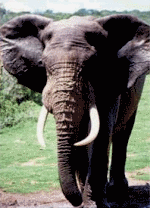 population size. South Africa slaughtered a total of 14,562 elephants between 1967 and 1994.
Developed by the S. African wildlife vet, Hank Bertschinger, the vaccine uses proteins extracted from eggs produced by female pigs to prevent sperm from fertilizing an elephant egg.
population size. South Africa slaughtered a total of 14,562 elephants between 1967 and 1994.
Developed by the S. African wildlife vet, Hank Bertschinger, the vaccine uses proteins extracted from eggs produced by female pigs to prevent sperm from fertilizing an elephant egg.